
Choosing where to go in Europe is harder than it should be. With over 40 countries and no shortage of “top 10” lists repeating the same five cities, narrowing it down usually means more scrolling, not more clarity.
This guide ranks the 15 most beautiful countries in Europe, explains what makes each one visually distinct, and helps you match a destination to your travel style, budget, season, and trip length — whether this is your first trip to the continent or your tenth.
What Makes a Country One of the Most Beautiful in Europe?
“Beautiful” is subjective, but not arbitrary. A few criteria show up consistently across the countries that top these lists:
Natural landscapes. Mountains, fjords, volcanic terrain, ancient forests, dramatic cliffs. Norway and Iceland lead here almost by default.
Beaches and coastlines. From Croatia’s turquoise Adriatic coves to Ireland’s wild Atlantic beaches, coastal quality, accessibility, and diversity all factor into the ranking.
Mountains, lakes, and waterfalls. Switzerland, Austria, Slovenia, and Norway are the standouts for alpine scenery and highland lakes.
Historic cities and architecture. Nature alone rarely justifies a standalone trip. Gothic cathedrals, Ottoman-era fortresses, and Renaissance city centers raise a country’s overall appeal considerably.
Villages and countryside. Tuscany’s hills, England’s Cotswolds, Portugal’s wine valleys — some of Europe’s best travel moments happen well outside the capital cities.
Cultural and scenic variety. Italy, France, and Spain rank highly in part because a single trip can cover several genuinely different landscapes and cultures.

15 Most Beautiful Countries in Europe
These 15 aren’t ranked on a single score — each one leads in something specific. Find the category that matters most to you.
Italy — Best Overall for Beauty and Variety
Italy is the rare country that has genuinely everything. A single two-week trip can take you from the Dolomites to Tuscany’s cypress-lined hills, down the Amalfi Coast, through Venice’s canals, and into Rome’s 2,700 years of history. No other European country covers this much ground at this level of quality.
Amalfi Coast — Vertical cliffs, colorful towns stacked above the water, and a coastline that photographs better than almost anywhere in Europe. Positano, Ravello, and Atrani are the standouts.
Dolomites — Jagged, pink-tinged peaks in northeastern Italy, UNESCO-listed, with strong hiking in summer and skiing in winter.
Tuscany — Rolling hills, medieval hill towns like San Gimignano and Siena, and vineyards that reward slow travel over a packed itinerary.
Venice — A city with no real comparison: canals, Gothic palaces, car-free streets. It’s also fragile — rising water levels and overtourism are real concerns, so visiting off-season or with a lighter footprint matters here.
Rome — Ancient monuments, Baroque churches, and Renaissance art packed into a walkable center on a historical scale few cities can match.
Lake Como — Steep mountains ring the lake; elegant 18th-century villas line the shore. Bellagio and Varenna are the most scenic towns.

Switzerland — Best for Alpine Scenery
Switzerland is small, expensive, and about as beautiful as mountain scenery gets in Europe. What sets it apart isn’t just the Alps themselves but the infrastructure around them.
Swiss Alps — Cover roughly 60% of the country. Trains, cable cars, and well-maintained trails mean a world-class viewpoint is rarely more than a few minutes away.
Lauterbrunnen Valley — Often cited as an inspiration for Tolkien’s Rivendell: a narrow valley flanked by 1,000-meter cliffs with 72 waterfalls. Wengen, Mürren, and Grindelwald sit nearby, all car-free.
Lake Geneva — Vineyard-covered slopes on one side, the Alps on the other. The Lavaux terraces on the northern shore are UNESCO-listed and particularly striking.
Zermatt and the Matterhorn — One of the most recognizable mountain silhouettes in the world, with a car-free village at its base that works as both ski resort and year-round destination.
Interlaken — Sits between Lake Thun and Lake Brienz, with the Jungfrau massif behind it — the gateway to Switzerland’s best hiking and adventure sports.
Norway — Best for Dramatic Natural Landscapes
Norway’s fjords — long, glacier-carved inlets flanked by vertical cliffs — don’t really have an equivalent elsewhere in Europe. Add the Northern Lights, the Lofoten Islands, and near-endless summer daylight, and it becomes a genuinely singular destination.
Norwegian Fjords — Hardangerfjord, Sognefjord (the longest in the world at 204 km), and the UNESCO-listed Nærøyfjord represent the best of what fjord scenery can offer.
Lofoten Islands — An Arctic Circle archipelago with peaks rising straight from the sea, red fishermen’s cabins, and some of the clearest water in Norway.
Geirangerfjord — Often called Norway’s most beautiful fjord, flanked by the Seven Sisters waterfalls. The Dalsnibba viewpoint is one of the best in the country.
Bergen — Sits at the mouth of several fjords and works as a gateway to the western fjord region. Its UNESCO-listed Bryggen wharf is one of Scandinavia’s most photographed streetscapes.
Northern Lights — Northern Norway, particularly Tromsø and Svalbard, offers strong aurora viewing between late September and late March.
France — Best for Diverse Landscapes and Culture
France is the world’s most-visited country, and the range it offers within its own borders is a big reason why: Mediterranean coastline, Alpine ski resorts, Atlantic beaches, volcanic plateaus, and Paris.
French Riviera — Nice, Cannes, Antibes, Èze — glamorous coastal scenery with clear Mediterranean water and ochre-and-terracotta architecture.
Provence — Lavender fields around Valensole and Sault peak in late June and early July. Outside that window, medieval villages and Roman ruins carry the region.
French Alps — Chamonix, at the foot of Mont Blanc, anchors the French Alps. The Mer de Glace glacier and Aiguille du Midi cable car are the standout high-altitude experiences.
Paris — Urban beauty and architectural consistency at a level few cities match, from the Seine’s riverbanks to Haussmann’s boulevards.
Loire Valley — Home to over 300 châteaux, including Chambord, Chenonceau, and Villandry. UNESCO-listed and one of Europe’s most elegant rural landscapes.
Annecy — Called the “Venice of the Alps”: a glacial lake, old-town canals, and exceptional water clarity.
Greece — Best for Islands and Mediterranean Beauty
Greece’s coastline runs over 13,000 kilometers — the longest in the Mediterranean — spread across more than 6,000 islands, roughly 200 of them inhabited.
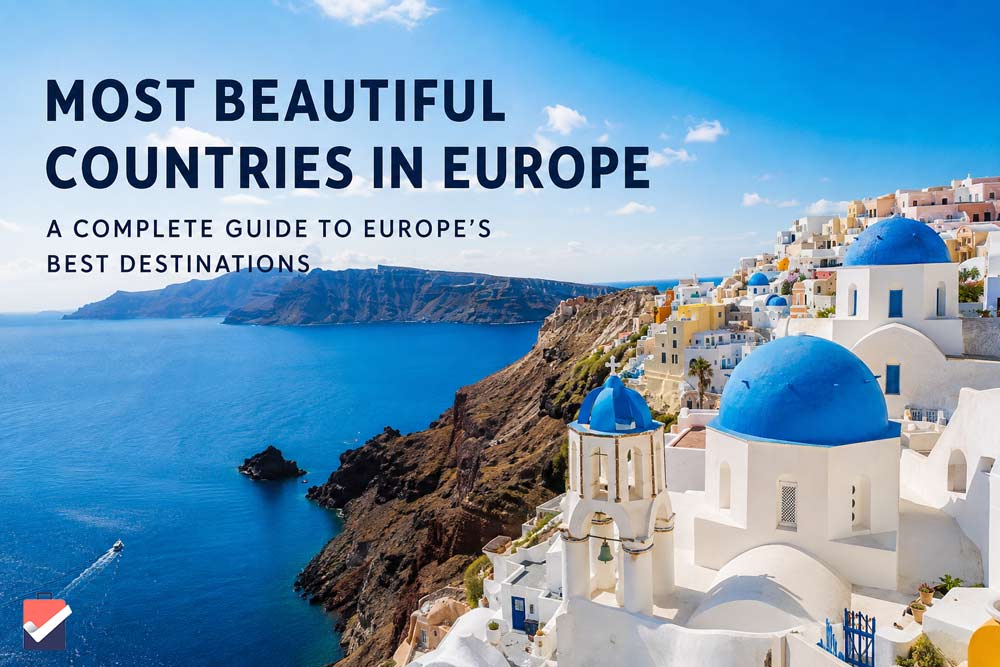
Santorini — The caldera left by a volcanic eruption around 3,600 years ago is ringed by white-washed villages on sheer cliffs. Oia at sunset is one of the most photographed views in the world — and one of the most crowded, so timing your visit matters.
Crete — Greece’s largest island, home to the Samaria Gorge, the Minoan Palace of Knossos, and coastline ranging from the turquoise Balos lagoon to the forested Sfakia region.
Milos — Less famous than Santorini, arguably more varied: volcanic rock formations, sea caves, and over 70 beaches. Sarakiniko’s white pumice rock looks closer to a moonscape than a Mediterranean shore.
Meteora — Byzantine monasteries perched on sandstone pillars rising from the Thessaly plain — one of the most visually extraordinary sites in Europe.
Athens — The Acropolis is visible from much of the city. Athens is grittier than many European capitals, but the concentration of history within walking distance is unmatched.
Greek Coastline — The Peloponnese, the Ionian Islands (Kefalonia, Zakynthos), and the Dodecanese (Rhodes, Kos) offer excellent coastal scenery with far fewer visitors than the Cyclades.
Spain — Best for Beaches, Cities, and Architecture
Spain pairs some of Europe’s best urban architecture with coastlines ranging from the rugged Costa Brava to Mallorca’s beaches, plus the standout landscapes of Andalusia.
Andalusia — The Sierra Nevada, the white hill villages (pueblos blancos), and the Moorish architecture of Granada and Córdoba make this one of Europe’s richest regions, scenically and culturally.
Costa Brava — Catalonia’s “wild coast”: pine-covered cliffs, turquoise coves, fishing villages. Salvador Dalí spent much of his life here — the landscape makes it obvious why.
Mallorca — More than a beach destination: the Sierra de Tramuntana mountains, hidden eastern coves, and Palma’s culture and architecture.
Barcelona — Defined by its concentration of Modernisme architecture — Gaudí’s Sagrada Família and Park Güell, Domènech i Montaner’s Palau de la Música Catalana — packed into a compact, walkable grid.
Seville — The Alcázar, the Gothic cathedral, the Barrio Santa Cruz. In spring, with orange blossom and mild temperatures, it’s one of Europe’s best walking cities.
Granada — The Alhambra, a 13th-century Nasrid palace overlooking the city from the Sierra Nevada, ranks among the finest examples of Islamic architecture anywhere.
Iceland — Best for Otherworldly Natural Scenery
Iceland plays by different rules — no famous historic cities, no ancient ruins, no Mediterranean coast. Instead: active volcanoes, geothermal springs, black-sand beaches, and waterfalls on a scale unmatched elsewhere in Europe.
Waterfalls — Skógafoss and Seljalandsfoss sit right off the Ring Road; Godafoss is the “waterfall of the gods”; Dettifoss, in the north, is Europe’s most powerful waterfall.
Glaciers — Iceland holds roughly 11% of Europe’s remaining glacier coverage. Vatnajökull, the continent’s largest glacier, is accessible via guided walks, and the Jökulsárlón glacier lagoon — where icebergs calve straight into the water — is one of Europe’s most striking natural sights.
Black-Sand Beaches — Reynisfjara, near Vík, combines volcanic sand, basalt sea stacks, and heavy North Atlantic surf.
Volcanoes — Iceland sits on the Mid-Atlantic Ridge with around 30 active volcanic systems. The 2010 Eyjafjallajökull eruption and more recent activity on the Reykjanes Peninsula near Grindavík have kept the country’s volcanism visible — and, at times, visitable, though access shifts with ongoing activity, so check current conditions before planning a trip there.
Geothermal Landscapes — The Haukadalur valley (Geysir, Strokkur) is part of the Golden Circle, Iceland’s most popular day-trip route.
Northern Lights — Best viewed away from Reykjavik’s light pollution, roughly September through March.
Croatia — Best for Adriatic Coastlines and Historic Towns
Croatia has become one of Europe’s most in-demand summer destinations over the last two decades — the coastline, 1,200-plus islands, and Plitvice Lakes National Park are the main reasons.
Dubrovnik — A medieval walled city on a rocky peninsula. Walking the city walls is a classic European experience, though peak-season crowds are heavy — early morning or a May/October visit changes things considerably.
Plitvice Lakes — Sixteen terraced lakes connected by waterfalls, set in a forested canyon. UNESCO-listed and Croatia’s most-visited natural attraction.
Split — A functioning modern city built into the 4th-century Palace of Diocletian — restaurants and apartments now occupy what were once imperial quarters.
Hvar — One of Europe’s sunniest islands (over 2,700 hours of sunshine a year), with lavender hills, Venetian-era architecture, and the Pakleni Islands nearby.
Istria — More Italian in character than the Dalmatian coast, with truffle forests and hilltop towns. Rovinj, a former Venetian fishing port, is among the Adriatic’s most picturesque towns.
Adriatic Islands — Brač, Korčula, Vis, and Mljet each have distinct character. Vis, only opened to tourism in 1989, has kept more of its original quiet.
Austria — Best for Alpine Towns and Classic European Scenery
Austria is often overshadowed by Switzerland and Germany, but the Austrian Alps are spectacular, Hallstatt is one of the most-photographed villages anywhere, and Vienna is one of Europe’s most elegant capitals.
Austrian Alps — Includes the Hohe Tauern range (home to Grossglockner, Austria’s highest peak at 3,798 m) and the Tyrolean Alps around Innsbruck. The Grossglockner High Alpine Road (open May–November) is one of Europe’s best scenic drives.
Hallstatt — A lakeside village whose reflection in the Hallstätter See, backed by limestone mountains, has made it one of the most photographed places in the world. Genuinely stunning, and genuinely crowded in summer.
Salzburg — Mozart’s birthplace, set in a mountain bowl with the Hohensalzburg fortress above and a baroque center below.
Innsbruck — A compact historic center with the golden-roofed Imperial Palace, backed by the near-vertical Nordkette range — reachable by cable car in minutes.
Vienna — The Hofburg Palace, the Kunsthistorisches Museum, the Ringstrasse boulevard, and a coffee-house culture that adds real texture to the city.
Lake Regions — The Salzkammergut district holds over 70 lakes. Wolfgangsee, Mondsee, and Traunsee are just as scenic as Hallstatt and considerably less crowded.
Portugal — Best for Coastal Scenery and Charming Cities
Portugal has repositioned itself over the last decade from “budget alternative to Spain” to one of Europe’s most genuinely attractive countries — strong coastal scenery, two charming capitals-in-spirit (Lisbon and Porto), and landscapes stretching to the volcanic Azores.
Algarve — Golden limestone cliffs eroded into sea caves and arches. Praia da Marinha, Ponta da Piedade, and Praia do Camilo are standouts.
Lisbon — Built across seven hills above the Tagus. Cobbled streets, azulejo tiles, yellow trams, and sweeping miradouro viewpoints.
Porto — Compact and hilly: the Ribeira waterfront, the Livraria Lello bookshop, the tiled São Bento station, and the view from the Dom Luís bridge.
Douro Valley — Terraced vineyards on steep schist hillsides above the river, producing port wine grapes. Best in autumn, when the vines turn gold.
Madeira — A subtropical island 1,000 km southwest of the mainland: volcanic peaks, UNESCO-listed laurisilva forest, and the levada irrigation-channel hiking trails.
Azores — Nine volcanic islands mid-Atlantic, with crater lakes, geysers, and whale watching. Faial, Pico (Portugal’s highest mountain), and São Miguel are the standouts.
Slovenia — Best for Lakes, Mountains, and Compact Natural Beauty
Slovenia is arguably the most underrated country on this list — roughly the size of Switzerland, with a fraction of the visitors, and enough variety (Julian Alps, Karst plateau, Adriatic coast, a charming capital) to explore properly in a week.
Lake Bled — A glacial lake with an island church at its center and a cliffside medieval castle. Early morning, before tour groups arrive, is the time to see it.
Lake Bohinj — Twenty kilometers from Bled, larger and quieter, set deeper in Triglav National Park.
Soča Valley — The Soča River runs an almost unreal emerald color from glacial light refraction. Most vivid in spring during peak snowmelt.
Triglav National Park — Covers most of the Julian Alps, including Triglav itself (2,864 m). Some of the best hiking in the Alps, with far fewer crowds than Switzerland or Austria.
Ljubljana — A hilltop castle, a river lined with cafes, and a walkable, largely traffic-free old town. Genuinely undervisited relative to its charm.
Ireland — Best for Green Landscapes and Rugged Coastlines
Ireland’s light — soft, changeable, atmospheric — makes even an overcast day photogenic. The Wild Atlantic Way stretches 2,500 km along the west coast.
Cliffs of Moher — Rising 214 m above the Atlantic, Ireland’s most-visited natural attraction, with clear-day views to the Aran Islands.
Ring of Kerry — A 179 km circular route through mountain passes and coastal villages on the Iveragh Peninsula, with the MacGillycuddy’s Reeks running through the center.
Wild Atlantic Way — The full 2,500 km route from Donegal to Cork passes some of Ireland’s least-visited coastal scenery, including the Dingle Peninsula and Connemara.
Galway — Ireland’s most culturally vibrant city outside Dublin, with a strong music scene and easy access to Connemara National Park.
Killarney National Park — Ireland’s oldest national park: three lakes, ancient oak woodland, Ross Castle, and Carrauntoohil, Ireland’s highest peak.
Montenegro — Best for Dramatic Scenery on a Smaller Scale
Montenegro packs a stunning Adriatic coastline, a deep canyon river, medieval walled towns, and high mountain plateaus into a country barely larger than Northern Ireland — and it remains far less visited than Croatia just to the north.
Bay of Kotor — Often called Southern Europe’s only fjord, though technically a submerged river canyon. Either way, it’s one of the Adriatic’s most striking landscapes.
Durmitor National Park — 48 peaks above 2,000 m, 18 glacial lakes, and the Tara River Canyon — at 1,300 m, one of the deepest gorges in the world. UNESCO-listed.
Kotor — A well-preserved medieval walled town; the walk up to the St John fortress takes about 30 minutes and delivers exceptional views.
Adriatic Coast — Short (around 293 km) but with genuinely fine beaches. Sveti Stefan — an island village turned luxury resort — is one of the Balkans’ most distinctive coastal images.
Mountain Landscapes — Within 50 km, the terrain shifts from Mediterranean beach to alpine plateau. The Komovi mountains and the Prokletije range offer wilderness hiking rarely found this close to the coast.
Albania — Best for Underrated Coastal and Mountain Scenery
Albania is the least-visited country on this list, and the gap between quality and visitor numbers is real. The Albanian Riviera rivals any Mediterranean coastline for water clarity, the Albanian Alps are genuinely dramatic, and Berat and Gjirokastër are two of the most interesting historic cities in the Balkans.
Albanian Riviera — Sarandë to Ksamil, and north through Himara and Dhermi: turquoise water, white pebble beaches, and a mountain backdrop often compared to the Greek islands, at a fraction of the price.
Ksamil — Albania’s most popular beach destination, with small offshore islands and very clear water. Quiet outside July and August.
Theth — A glacial-valley village in the Albanian Alps, with the Grunas Canyon and the Blue Eye spring nearby.
Berat — The “city of a thousand windows,” a UNESCO-listed Ottoman-era hill town split by the Osum River into the Mangalem and Gorica quarters.
Gjirokastër — Albania’s second UNESCO-listed city, a stone-built hill town with a castle visible from the surrounding valley — also the birthplace of former dictator Enver Hoxha, giving it a layered history alongside its architecture.
Albanian Alps — The Peaks of the Balkans trail (192 km, through Albania, Kosovo, and Montenegro) is one of Europe’s most dramatic mountain routes; the Albanian section around Valbona and Theth is the highlight.
Czech Republic — Best for Fairytale Towns and Historic Beauty
The Czech Republic’s strongest card is architectural: Prague is one of Europe’s most intact historic cities, and the Bohemian countryside beyond it sees a fraction of the visitors.
Prague — Hradčany Castle, the Charles Bridge, the Old Town Square. The historic center survived the 20th century largely intact — most atmospheric in winter, when crowds thin.
Český Krumlov — A near-perfectly preserved medieval town in a bend of the Vltava River, dominated by its castle complex. UNESCO-listed; best seen in the morning before tour coaches arrive.
Bohemian Countryside — Includes the spa triangle (Karlovy Vary, Mariánské Lázně, Františkovy Lázně — UNESCO-listed as part of the Great Spa Towns of Europe), the sandstone formations of Bohemian Switzerland National Park, and Moravian wine country around Mikulov.
Castles — The Czech Republic has an unusually high density of castles per square kilometer. Karlštejn, Konopiště, and Hluboká are the most accessible from Prague.
Historic Architecture — Beyond Prague and Český Krumlov: Olomouc’s baroque fountains, UNESCO-listed Telč, and Kutná Hora’s bone church.
Table 15 Most Beautiful Countries in Europe at a Glance
| Country | Best For | Must-See Destination | Best Season | Approx. Budget Level |
|---|---|---|---|---|
| Italy | Overall variety | Amalfi Coast / Dolomites | Apr–Jun, Sep–Oct | Medium–High |
| Switzerland | Alpine scenery | Lauterbrunnen Valley | Jun–Sep, Dec–Feb | Very High |
| Norway | Dramatic nature | Norwegian Fjords | May–Sep (summer), Sep–Mar (lights) | High |
| France | Cultural + landscape diversity | Provence / Loire Valley | Apr–Jun, Sep | Medium–High |
| Greece | Islands and Mediterranean | Santorini / Milos / Meteora | May–Jun, Sep | Medium |
| Spain | Beaches, cities, architecture | Alhambra / Barcelona / Mallorca | Mar–May, Sep–Nov | Medium |
| Iceland | Otherworldly landscapes | Jökulsárlón / Lofoten | Jun–Aug (landscape), Sep–Mar (lights) | High |
| Croatia | Adriatic coast and towns | Dubrovnik / Plitvice Lakes | May–Jun, Sep | Medium |
| Austria | Alpine towns + culture | Hallstatt / Vienna | Jun–Sep, Dec–Feb | High |
| Portugal | Coastal scenery + charming cities | Algarve / Porto | Mar–May, Sep–Oct | Low–Medium |
| Slovenia | Compact natural beauty | Lake Bled / Soča Valley | May–Sep | Low–Medium |
| Ireland | Green landscapes + wild coasts | Cliffs of Moher / Wild Atlantic Way | May–Sep | Medium |
| Montenegro | Dramatic scenery on small scale | Bay of Kotor / Durmitor NP | May–Sep | Low–Medium |
| Albania | Underrated beaches + mountains | Albanian Riviera / Theth | May–Sep | Low |
| Czech Republic | Fairytale towns + architecture | Prague / Český Krumlov | Mar–May, Sep–Nov | Low–Medium |
The Most Beautiful European Countries by Travel Style
Start with what you actually want to see or do — it’s a more practical filter than any ranking.
Mountain scenery: Switzerland leads for accessibility. Norway’s fjords deliver the most dramatic vertical relief. Italy’s Dolomites offer a warmer, more textured alternative. Austria and Slovenia round out the top tier without Switzerland’s price tag.
Beaches and coastlines: Greece has the deepest bench of quality beaches and island culture. Croatia matches its water clarity in a more compact geography. Portugal’s Algarve is one of the finest cliff-backed coastlines in Europe. Montenegro and Albania deliver similar quality for less money.
Lakes and waterfalls: Switzerland (Lake Geneva, Lake Lucerne), Slovenia (Lake Bled, Lake Bohinj), and Austria (Salzkammergut) top the list for alpine lakes. Norway’s Seven Sisters are the most dramatic in scale; Iceland’s are the most powerful and accessible.
Historic cities: Italy has the deepest bench — Rome, Florence, Venice, Siena, Bologna. France and Spain follow closely. The Czech Republic punches above its weight with Prague and Český Krumlov. Athens and Thessaloniki add a layer of ancient history most cities can’t match.
Picturesque villages: France (Provence, Alsace, Dordogne), Italy (Tuscany, Cinque Terre, Valle d’Aosta), and Portugal (Douro Valley, Minho) lead. Czech Moravian wine villages and Montenegro’s Bay of Kotor villages are excellent and undervisited.
Nature and hiking: Norway’s Trolltunga and Preikestolen trails are among Europe’s most dramatic. Iceland’s Highlands and Landmannalaugar offer genuinely unique terrain. Slovenia’s Triglav and Albania’s Peaks of the Balkans trail are exceptional and far less crowded than comparable areas.
Romantic scenery: Italy remains the standard-bearer. France (Provence, the Loire) is close behind. Santorini, Porto, and Hallstatt are standout individual destinations.
Photography: Iceland and Norway offer the most dramatic light — golden summer hours and winter aurora. Italy has the widest variety of subjects. Albania and Montenegro offer excellent scenery without the same crowds in every frame.
Table Travel Style vs. Best Countries and Recommended Destinations
| Travel Style | Top Countries | Recommended Destinations |
|---|---|---|
| Mountain scenery | Switzerland, Norway, Italy | Lauterbrunnen, Dolomites, Geirangerfjord |
| Beaches and coastlines | Greece, Croatia, Portugal | Milos, Hvar, Algarve |
| Lakes and waterfalls | Slovenia, Switzerland, Iceland | Lake Bled, Lauterbrunnen, Skógafoss |
| Historic cities | Italy, Czech Republic, Greece | Rome, Prague, Athens |
| Picturesque villages | France, Italy, Portugal | Gordes, Tuscany, Douro Valley |
| Nature and hiking | Norway, Iceland, Slovenia | Trolltunga, Landmannalaugar, Triglav |
| Romantic scenery | Italy, France, Greece | Tuscany, Provence, Santorini |
| Photography | Iceland, Norway, Albania | Jökulsárlón, Lofoten, Theth |
Which Are the Most Scenic Countries in Europe?
If “scenic” specifically means landscapes that feel overwhelming or unlike anywhere else, these are the strongest candidates.
Dramatic landscapes: Norway and Iceland lead by a wide margin. Montenegro and Albania offer similarly dramatic terrain on a smaller scale — Durmitor Canyon and the Albanian Alps are extraordinary and usually crowd-free.
Alpine scenery: Switzerland, Austria, and the Italian Dolomites are the three main contenders, each with a distinct character. Switzerland is the most accessible; the Dolomites are the most visually distinctive, especially the Pale di San Martino at sunset; Austria balances scenery with culture at a lower price point.
Coastal scenery: Portugal’s Atlantic cliffs, Croatia’s islands, Greece’s Cycladic coast, and Ireland’s wild west each offer a different flavor of coastal beauty. If forced to pick one, the Algarve covers the widest range of cliff, cove, and beach in a compact area.
Forests, lakes, and waterfalls: Slovenia’s mix of alpine lakes, emerald rivers, and beech forest is proportionally the most impressive relative to its size. Norway’s waterfall density is unmatched. Czech Bohemian Switzerland National Park is one of Central Europe’s more underrated natural landscapes.
Unique natural landscapes: Iceland stands alone — geysers, calderas, lava fields, ice caves, and black-sand beaches all within reach of one base. Plitvice Lakes, the Soča Valley, and Meteora each offer something that feels genuinely singular elsewhere.
[Image: Visual comparison of European landscape types including fjords, Alps, Mediterranean coastlines, and volcanic landscapes]
Best Beautiful Countries in Europe for Different Types of Travelers
First-time visitors: Italy, France, and Spain combine iconic experiences with strong tourism infrastructure and enough variety for a two-week trip. Portugal has become a compelling alternative — cheaper, less crowded, easier to navigate than a decade ago.
Couples: Italy and Greece remain the classic choices — good food, scenery, warm evenings. Porto and the Douro Valley are increasingly popular. Slovenia’s Lake Bled, the Albanian Riviera, and the Bay of Kotor offer similar romance at lower cost and crowds.
Families: Croatia’s coast works well — calm, clear water and walkable medieval towns. Austria’s alpine resorts pair outdoor activity with strong infrastructure. Ireland suits families wanting green landscapes and castles without a language barrier.
Nature lovers: Norway, Iceland, and Slovenia top the list. Albania’s Peaks of the Balkans trail offers excellent mountain scenery with minimal crowds. Ireland’s Wild Atlantic Way rewards those who don’t mind unpredictable weather.
Photographers: Iceland’s light — midnight sun, aurora, black rock against white ice — makes it exceptional. Norway’s fjords, the Albanian Alps, and Greece’s volcanic landscapes (Milos, Santorini) are also strong. For architecture, Prague and Seville offer near-limitless material.
History and culture: Italy, Greece, and France offer the deepest layered history. Spain’s Moorish heritage in Andalusia stands out. The Czech Republic, Austria, and Portugal all have rich, underappreciated historical narratives.
Road trips: Iceland’s Ring Road — 1,332 km, drivable in about a week — is Europe’s most famous. Ireland’s Wild Atlantic Way and Ring of Kerry are excellent for coastal driving. Portugal’s Alentejo and Albania’s Riviera road are among the least congested options in their regions.
Table Traveler Type vs. Recommended Countries and Reasons
| Traveler Type | Top Countries | Key Reason |
|---|---|---|
| First-time visitors | Italy, France, Spain | Iconic sights + strong infrastructure |
| Couples | Italy, Greece, Portugal | Scenery + food + atmosphere |
| Families | Croatia, Austria, Ireland | Safe, accessible, activity-rich |
| Nature lovers | Norway, Iceland, Slovenia | Wild landscapes, hiking, wildlife |
| Photographers | Iceland, Norway, Albania | Extraordinary light + unusual terrain |
| History and culture | Italy, Greece, Czech Republic | Depth of historical sites |
| Road trips | Iceland, Ireland, Portugal | Scenic routes + manageable distances |
Best Time to Visit the Most Beautiful Countries in Europe
Spring (March–May): Mild temperatures and manageable crowds across Southern Europe. Portugal and Andalusia are strong with wildflowers and orange blossom. Greece’s islands and archaeological sites see far fewer crowds than summer. Tuscany in April–May, before the heat sets in, is one of the best windows of the year.
Summer (June–August): Peak season nearly everywhere. Norway is at its most accessible — fjords navigable, trails open, midnight sun. Iceland’s Highland interior roads open up. Croatia and Greece are best for beaches in June and September; July–August hit maximum capacity on the popular islands.
Autumn (September–November): Often undervalued. Italy’s harvest season, France’s grape harvest, and Slovenia’s fall foliage are excellent conditions. Portugal’s Douro Valley during the September harvest is one of Europe’s best seasonal experiences. Czech Republic and Austria in October offer thinner crowds and strong atmosphere.
Winter (December–February): Switzerland and Austria shine, with ski resorts and Christmas markets. Iceland offers the best odds for the Northern Lights. Portugal, Spain, and Greece stay mild enough for comfortable winter travel at lower cost.
Shoulder season: April–May and September–October generally offer the best balance of weather, crowds, and cost. For beach destinations, early June and late September come close to summer conditions with a fraction of the crowds. For mountains, mid-September to mid-October brings strong hiking weather and early autumn color.
Most Beautiful Countries in Europe on a Budget
Affordable options: Albania is the most affordable country on this list by a wide margin. Montenegro, North Macedonia, and Bosnia and Herzegovina offer similar value in the Western Balkans. Slovenia costs more than its Balkan neighbors but considerably less than Switzerland or Austria for comparable mountain scenery.
Best value for nature lovers: Albania and Montenegro offer hiking comparable to Switzerland or Norway at a fraction of the cost. Slovenia’s Triglav National Park is good value relative to Switzerland, though increasingly popular. Iceland can be made significantly more affordable with off-season timing and self-catering.
Balkan value: Albania, Montenegro, Bosnia and Herzegovina, and North Macedonia combine natural beauty, Ottoman and Byzantine heritage, and affordability. The Albanian Riviera, the Bay of Kotor, Mostar’s Stari Most, and Lake Ohrid together form one of Europe’s most underrated travel circuits — achievable on a budget that covers only a few days in Switzerland or Norway.
Cutting costs in expensive destinations:
- Travel in shoulder season — accommodation in Norway’s Lofoten Islands or Switzerland’s Lauterbrunnen runs noticeably cheaper in May and September than peak summer.
- Base yourself outside the most famous villages — Interlaken is cheaper than Zermatt or Grindelwald, with excellent transport links either way.
- Self-cater where possible, especially in Iceland, where restaurant costs add up fast.
- Take overnight trains in France and Italy to cover distance without paying for a night’s accommodation.
- Lean on free attractions — Norway’s fjords, Ireland’s coastline, Iceland’s waterfalls, and Greece’s historic villages cost nothing to visit.
How Many European Countries Can You Visit on One Trip?
The most common planning mistake is trying to cover too many countries — the result is a trip built around trains and airports, with surface-level impressions of everywhere and real time in nowhere.
The strongest combinations share a border or a short transport link, complement each other scenically or culturally, and leave enough time to actually settle in.
7 days:
- Slovenia + Croatia — Lake Bled and Ljubljana, then south to Split and the Dalmatian islands.
- Portugal alone — Lisbon (3 days), Porto (2 days), Douro Valley (2 days). Enough internal variety that a border crossing isn’t missed.
- Austria + Slovenia — Vienna and Hallstatt, then Lake Bled and Ljubljana.
10–14 days:
- Northern Italy — Dolomites, Venice, Florence, Tuscany.
- Greece island-hop — Athens, Santorini, Milos, Crete, connected by ferry.
- France + Spain — French Riviera and Provence, then Barcelona into Andalusia. Ambitious but doable if you stay focused.
- Albania + Montenegro + Croatia — Albanian Riviera, Bay of Kotor, Dubrovnik: three distinct coastlines, reasonable cost.
3 weeks:
- Western Balkans circuit — Slovenia → Croatia → Montenegro → Albania. Big scenic variety at a fraction of Western European cost.
- Southern Europe — Portugal → Spain (Andalusia, Barcelona) → France (Riviera, Provence) → Italy (Tuscany, Rome).
- Nordic circuit — Iceland (1 week) → Norway’s fjords and Bergen (1 week) → Copenhagen (3 days). Expensive, but arguably the most dramatic natural scenery achievable on one trip.
Why fewer countries can mean a better trip: A week in Tuscany — a farmhouse, different hill towns each day, unplanned detours — creates a fundamentally different experience than one night each in five cities. The same logic applies to Norway’s fjords or the Douro Valley: these places reward time. The instinct to maximize country count is understandable, but the trips people actually remember are usually the ones where they stayed somewhere long enough to feel it.
Most Beautiful Places to Visit in Each Country
Iconic destinations:
- Italy: Positano (Amalfi Coast), Alpe di Siusi (Dolomites), San Gimignano (Tuscany), Canal Grande (Venice)
- Switzerland: Jungfraujoch, Lauterbrunnen, Zermatt, Grindelwald
- Norway: Preikestolen, Trolltunga, Geirangerfjord viewpoint, Lofoten Islands (Reine)
- France: Mont Saint-Michel, Gordes (Provence), Annecy Old Town, Palais des Papes (Avignon)
- Greece: Oia (Santorini), Sarakiniko (Milos), Meteora monasteries, Navagio Beach (Zakynthos)
- Spain: Alhambra (Granada), Sagrada Família (Barcelona), Ronda, Teide National Park (Tenerife)
- Iceland: Jökulsárlón, Landmannalaugar, Dyrhólaey arch, Lake Mývatn
- Croatia: Plitvice Lakes, Old Town Dubrovnik, Hvar Town, Rovinj
- Austria: Hallstatt, Grossglockner High Alpine Road, Schönbrunn, Hohensalzburg Fortress
- Portugal: Pena Palace (Sintra), Ponta da Piedade, Douro Valley terraces, Faial (Azores)
- Slovenia: Lake Bled, Soča Valley, Predjama Castle, Postojna Cave
- Ireland: Cliffs of Moher, Skellig Michael, Kylemore Abbey, Slea Head Drive
- Montenegro: Sveti Stefan, Bay of Kotor, Tara River Canyon, Durmitor National Park
- Albania: Ksamil, Blue Eye spring, Theth, Berat Old Town
- Czech Republic: Prague Old Town Square, Český Krumlov Castle, Bohemian Switzerland NP, Telč
Hidden gems:
- Italy: Civita di Bagnoregio (Viterbo), the Orcia Valley outside peak season, the Langhe wine region
- Greece: Zagori villages in Epirus, the Mani Peninsula, Folegandros
- Portugal: Monsanto (built around boulders), Serra da Estrela, the Alentejo plains
- Croatia: Vis Island, Pag Island’s lunar landscape, the Krka River upstream from the tourist zone
- Norway: Hjørundfjord, Ålesund’s Art Nouveau center, Jotunheimen National Park
Most beautiful cities: Prague, Venice, Porto, Dubrovnik, Hallstatt, Ljubljana, Kotor, Seville, Bergen, Annecy
Most beautiful villages: Positano (Italy), Hallstatt (Austria), Civita di Bagnoregio (Italy), Berat (Albania), Oia (Greece), Český Krumlov (Czech Republic), Kotor (Montenegro)
Most scenic natural attractions:
- Most dramatic: Geirangerfjord, Jökulsárlón, Preikestolen, the Dolomites
- Most unusual: Sarakiniko, the Soča River, Tara Canyon, Meteora
- Most underrated: Theth, the Albania/Kosovo peaks, Pag Island, the Epirus mountains

How to Choose the Best European Country for Your Trip
By scenery: Mountains — Switzerland, Norway, the Dolomites. Coastlines — Greece, Croatia, Portugal. Variety within one country — Italy. Landscapes unlike anywhere else — Iceland.
By budget: The Western Balkans (Albania, Montenegro, Slovenia) offer the best scenery-to-cost ratio. Portugal and Czech Republic are strong value in Western Europe. Switzerland, Norway, and Iceland need more careful budgeting but are workable with shoulder-season timing and self-catering.
By season: Norway’s fjords are most accessible May–September. Iceland’s Northern Lights need a September–March visit. Greece’s islands peak in June and September (July/August get crowded). Switzerland and Austria run two distinct peak seasons — summer hiking, winter skiing.
By trip length: 4–5 days suits a compact country like Slovenia or Montenegro. A week works for Portugal, Ireland, or Croatia. Two weeks opens up Italy, France, Norway, or a multi-country Balkan circuit. Three weeks justifies Iceland or a full Southern European circuit.
By activity:
- Skiing: Switzerland, Austria, French Alps
- Hiking: Norway, Iceland, Slovenia, Albania
- Beach and swimming: Greece, Croatia, Montenegro, Albania, Portugal
- Cultural sightseeing: Italy, France, Czech Republic, Spain
- Photography: Iceland, Norway, Albania, Greece (Milos)
- Food and wine: Italy, France, Spain, Portugal
By crowd tolerance: For lighter crowds, lean toward Albania, Montenegro, Slovenia, and the quieter Greek islands (Folegandros, Milos, Koufonisia) over Santorini, Dubrovnik, or Venice in peak season — the scenery holds up, and the cost and crowd trade-off is usually worth it.
Most Beautiful Countries in Europe: Quick Comparison
Table Country Quick Comparison Reference
| Country | Best For | Top Attraction | Best Season | Budget Level | Ideal Trip Length |
|---|---|---|---|---|---|
| Italy | All-round variety | Amalfi Coast / Dolomites | Apr–Jun, Sep–Oct | Medium–High | 10–14 days |
| Switzerland | Alpine scenery | Lauterbrunnen Valley | Jun–Sep | Very High | 7–10 days |
| Norway | Dramatic nature | Geirangerfjord / Lofoten | May–Sep | High | 7–10 days |
| France | Culture + landscapes | Provence / Loire Valley | Apr–Jun, Sep | Medium–High | 10–14 days |
| Greece | Islands + Mediterranean | Santorini / Milos | May–Jun, Sep | Medium | 10–14 days |
| Spain | Beaches + architecture | Alhambra / Barcelona | Mar–May, Sep–Nov | Medium | 10–14 days |
| Iceland | Otherworldly scenery | Jökulsárlón / Ring Road | Jun–Aug; Sep–Mar (lights) | High | 7–10 days |
| Croatia | Adriatic coast | Dubrovnik / Plitvice | May–Jun, Sep | Medium | 7–10 days |
| Austria | Alpine towns + culture | Hallstatt / Vienna | Jun–Sep, Dec–Feb | High | 7 days |
| Portugal | Coastal beauty + cities | Algarve / Porto | Mar–May, Sep–Oct | Low–Medium | 7–10 days |
| Slovenia | Compact natural beauty | Lake Bled / Soča Valley | May–Sep | Low–Medium | 5–7 days |
| Ireland | Wild coastlines | Cliffs of Moher / WAW | May–Sep | Medium | 7–10 days |
| Montenegro | Dramatic Balkans scenery | Bay of Kotor / Durmitor | May–Sep | Low–Medium | 5–7 days |
| Albania | Underrated beaches + peaks | Albanian Riviera / Theth | May–Sep | Low | 5–7 days |
| Czech Republic | Historic towns | Prague / Český Krumlov | Mar–May, Sep–Nov | Low–Medium | 5–7 days |
Frequently Asked Questions About the Most Beautiful Countries in Europe
What is the most beautiful country in Europe?
There’s no single objective answer, but Italy comes closest to a universal one — world-class coast (Amalfi), mountains (Dolomites), historic cities (Rome, Florence, Venice), and countryside (Tuscany) at a level of variety few countries match. Switzerland is the strongest pure-nature competitor; Iceland and Norway lead for dramatic, otherworldly landscapes. Which one is “most beautiful” ultimately depends on what kind of scenery you value.
What are the 10 prettiest countries in Europe?
By a combination of natural scenery, architecture, cultural variety, and overall appeal: Italy, Switzerland, Norway, France, Greece, Iceland, Croatia, Portugal, Slovenia, and Austria. Each leads in at least one category.
Which country in Europe has the most beautiful scenery?
For landscapes that feel genuinely unlike anywhere else, Iceland and Norway lead. Iceland’s volcanic terrain, glaciers, black-sand beaches, and geothermal features have no real equivalent elsewhere in Europe; Norway’s fjords are the world’s most dramatic example of glacier-carved coastline.
What is the best country to visit in Europe for the first time?
Italy and France remain the most common, justified picks — iconic sights, strong transport infrastructure, wide English proficiency, and enough variety for most interests. Portugal is an increasingly recommended alternative: cheaper, less crowded, easier to navigate than France or Italy, with comparable quality.
Which European country is best for nature lovers?
Norway for consistency and accessibility, Iceland for genuinely unique terrain, Slovenia for the best nature-to-cost ratio. Albania’s mountains and coastline offer excellent scenery with minimal crowds if you’re willing to go slightly off the beaten path.
What is the most beautiful European country for beaches?
Greece has the widest range — Santorini’s volcanic black sand, Milos’s colored rock, the Ionian Islands’ turquoise water. Croatia matches the water clarity in a more compact area. Portugal’s Algarve has Europe’s best cliff-backed beaches. Montenegro and Albania offer similar quality at a lower price.
Which European countries are the most affordable to visit?
Albania is the most affordable on this list by a wide margin. Montenegro, Slovenia, and the Czech Republic are considerably cheaper than Western Europe. Portugal and Greece sit at the more affordable end of Western Europe. Switzerland, Norway, and Iceland are the most expensive.
What are the best European countries to visit in summer?
Norway and Iceland are most accessible and comfortable June–August. Greece and Croatia are best for beaches in June and September, with July–August peaking for both weather and crowds. Provence is at its best in early summer. Ireland is at its most reliably pleasant in summer — though “reliable” is relative for Irish weather.
Which European countries are best for a scenic road trip?
Iceland’s Ring Road (1,332 km, about a week) is the most celebrated in Europe. Ireland’s Wild Atlantic Way (2,500 km) works well in sections. Portugal’s Alentejo and Algarve offer strong driving with light traffic. Albania’s SH8 coastal road from Sarandë to Vlorë is one of the more underrated drives in Europe.
Can you visit multiple beautiful countries in Europe in one trip?
Yes — some combinations work especially well. A Balkan circuit (Slovenia, Croatia, Montenegro, Albania) covers four distinct scenic identities in about two weeks. An Alpine circuit (Switzerland, Austria, northern Italy) works on a similar timeframe. The key is choosing countries with a shared geographic or thematic logic rather than collecting as many stamps as possible — the most memorable trips tend to go deeper into fewer places.
Planning Your European Trip
The 15 countries above represent Europe’s best, but “best” only means something once it’s matched to what you actually want. Standing above a Norwegian fjord as the morning mist lifts is a different ideal trip than sitting in a Tuscan farmhouse with a glass of local wine as the sun sets over cypress trees. Both are valid; both require choosing.
Start with the type of beauty that matters most to you — landscape, architecture, coastline, or culture — then apply the practical filters: season, budget, trip length, travel style. The list narrows fast from there.
If you’re still undecided, Italy is the safest first trip — it almost always delivers. If you’ve already done Italy, France, or Spain, the case for something less obvious — Slovenia, Albania, Montenegro, Norway — is stronger than it’s ever been. Infrastructure has improved, information is easy to find, and stepping slightly off the well-worn path tends to pay off.
